Early introduction can encourage more women to join STEM fields

Source:
Maybe you recall the Verizon commercial that follows a young girl as she’s growing up. Samantha takes a keen interest in activities like wading in a stream and building a rocket ship; activities that explore science, technology, engineering and math (STEM) fields. Yet she’s discouraged from pursuing those interests by the folks around her with comments like “Why don’t you hand that to your brother” or “Don’t get your dress dirty.” It concludes with a thoughtful question: Isn’t it time we told her she’s pretty brilliant, too? Not only does the commercial tug at your he
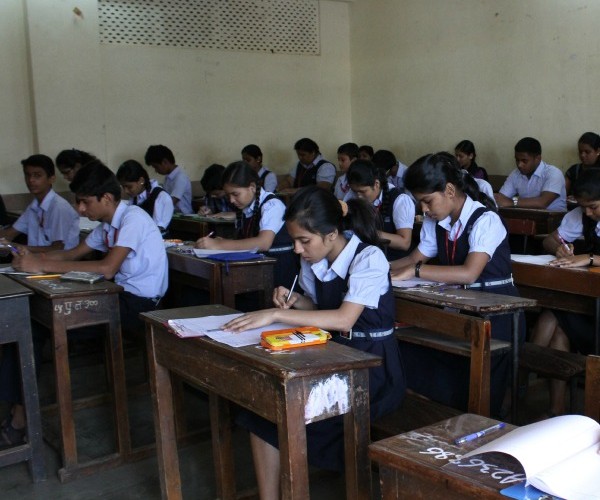
Female Literacy: What the Indian economy needs to learn from Sri Lanka

Source:
A study conducted by the Registrar General of India and the East-West Population Institute noted that: “The states in which female literacy rates are high, fertility rates typically are low. In those states that have low fertility rates, child mortality rates are also low.” Not only are overall female literacy rates for India way behind Sri Lanka (we are at 66% vs their 90%) but the situation is especially bad in the northern and western Indian states (literacy rates well below 60%). Interestingly, southern Indian states like Kerala (92%) and Tamil Nadu (74%) have female literacy rates and

40% of girls miss school due to lack of appropriate restrooms

Source:
As much as 40 percent of girls choose not to go to school for an average of three days each month when they have their period because there are no appropriate restroom facilities, according to a study by the International Center for Diarrhoeal Disease Research, Bangladesh (ICDDR,B). The National Hygiene Baseline Survey says that menstrual hygiene is a serious challenge for girls in Bangladesh due to a lack of understanding and general education about it.

UN report shows countries where it is hardest to be a woman

Source:
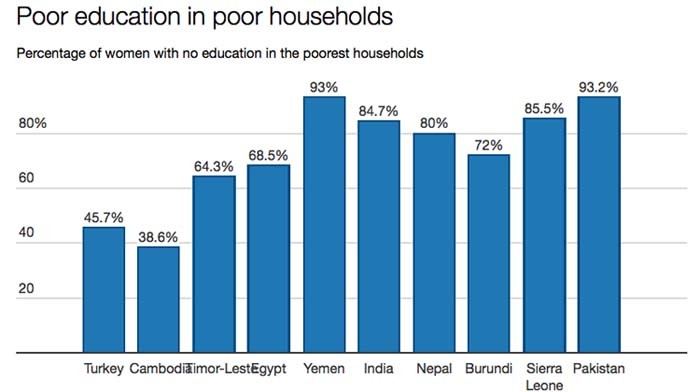
The United Nations organisation dedicated to gender equality, UN Women, has released a damning report on the progress of women worldwide. The UN has looked at the poorest 20 per cent of households and, within those, the level of education women have attained. (This doesn't involve statistics on developed countries such as Australia, New Zealand or the United States.) The report notes that women with little or no education are forced to accept whatever low-paid, low-skilled work is available. Yemen and Pakistan are standout non-performers, with 93 per cent of women in their poorest

Gender balance in small groups makes a big difference for women in STEM

Source:
A new study published in PNAS reports that female engineering students who are exposed to a higher percentage of female peers in small group interactions have increased levels of motivation, greater verbal participation, and feel more confident in their engineering career aspirations. This finding could have far-reaching implications for the gender imbalance that currently exists in engineering and related fields. This gender differential begins during education. In their first year of college, women are less likely than men to state an intention to pursue STEM education, and those numbers