





From Bletchley girls to Russian aces: the forgotten women at war
The Bletchley Girls
Tessa Dunlop
Hodder & Stoughton, 341pp, £20
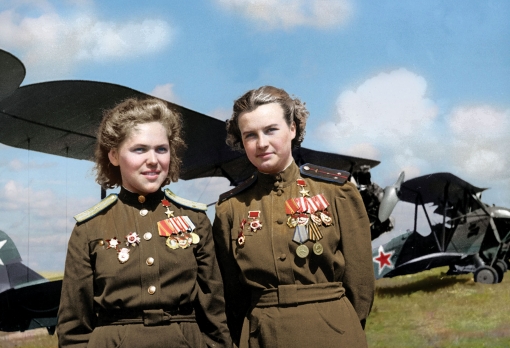
Defending the Motherland: the Soviet Women Who Fought Hitler’s Aces
Lyuba Vinogradova; translated by Arch Tait
MacLehose Press, 349pp, £20
This is real feminist history – work which was unheralded not just because it was top secret, but because women did it.
“It was astonishing what young women could be trained to do.” There is a note of surprise in the postwar review of the work that went on at Bletchley Park – for decades a site shrouded in secrecy but now known the world over as the place where the Nazis’ “unbreakable” Enigma code was cracked. That astonishment was found, Tessa Dunlop recounts in her lively history, The Bletchley Girls, in a section of the review entitled “Medium- or Low-Grade Labour”, which gives a good idea of the estimation in which most of the women who worked at Bletchley were held. But by 1944, there were three women for every man at Bletchley: women who were crucial to the success of the place but whose stories have barely been told.
This isn’t a book about the female cryptanalysts at Bletchley – and there were some, though the names of Hugh Alexander, Gordon Welchman, Harry Hinsley and Alan Turing have always eclipsed those of Joan Clarke (played by a skittery Keira Knightley in the dismal travesty that was The Imitation Game), Ruth Briggs, Margaret Rock and Mavis Lever. But those women are all dead now and Dunlop was determined to write a book full of living voices: an important task when we are, as far as the Second World War is concerned, approaching the limit of living memory. The youngest of her interviewees, Muriel Dindol, was 86; she was 14 when she went to work at Bletchley; Pamela Rose was 96, the oldest of the women Dunlop found to meet. There are 15 women in this book, their life stories ranging across the English social spectrum; women who worked behind the scenes, often with little idea of what it was exactly that they were doing. This is real feminist history.


