




Massive world military spending is driven by the profit motive of the arms industry and politicians’ weaponized notion of ‘security’. But women peace activists also hold militarized masculinity to account.
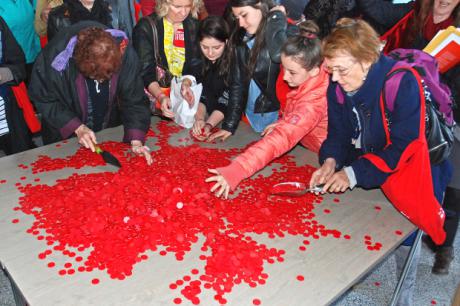
Unsurprisingly, world disarmament has featured prominently in the WILPF events in The Hague this week. It is, after all, the key goal in WILPF’s long struggle with national governments and the international system since the Armistice of 11 November 1918. On WILPF’s birthday, 28 April, we mounted a symbolic action outside the World Forum. Thousands of red plastic discs, symbolizing the world’s $1776 billion global military expenditure, were piled in a heap. Women, with shovels and with their hands, scooped up the coins and transferred them to accounts of their choice – ‘health’, ‘education’ or ‘human rights’.
Another persistent theme in the Centenary Congress and Conference has been gender relations. One of the commitments in the Manifesto adopted by Congress is to ‘transform gender from a power relation to one of partnership’. And the first plenary of the Conference addressed the male-dominant gender order as one of the ‘root causes’ of militarization and war. Speakers contributed ‘critical perspectives on the construction of violent masculinities, patriarchy, and engaging men’.
On the face of it, the two preoccupations, one with gender relations and the other with global military spending, may seem to have little connection. The first speaks of the human, intimate, individual and personal; the other of the machinery of war, missiles and military commands. And indeed the mainstream peace movements, comprising both men and women, tend not make the mental leap that is needed to bring them into a common analytic frame. On the other hand, it’s characteristic of the women’s peace movements, such as the Women’s International League for Peace and Freedom, the international network of Women in Black against War, and hundreds of smaller, more local women’s peace initiatives, that they do so. And the particular feature of gender relations they point to is the persistence of male dominance, accompanied (and indeed achieved) by the insistent shaping of masculinity, the ideal, preferred, form of manhood, as mentally competitive and combative; psychologically ready to use coercion; and physically equipped to prevail through force.


